Centres for Information Control? Medical data archiving as an act of resistance

by Hannah Schmalstich

Thursday, 30th of January 2025 – ten days after the second presidential inauguration of Donald Trump. Angela Rasmussen gets a call late in the evening from a reporter, asking if she had heard the rumors that the CDC website was going to be deleted.

Rasmussen, a virologist from the University of Saskatchewan, was alarmed by the news. The website for the Centres for Disease Control and Prevention (CDC) in the United States serves as a central hub for medical guidance, outbreak and disease tracking, and public health research for medical professionals and researchers around the world. For instance, an urgent care nurse may consult the website when considering care options (particularly in complicated cases). Rural areas, who do not have their own health departments, heavily rely on federal public health data, making them especially vulnerable to federal decision-making.

Rasmussen and several others began archiving CDC webpages and datasets using the Internet Archive (IA). By the 31st of January, site pages and data resources began to disappear. 

Some focused on public facing websites, including Rasmussen, data analyst Charles Gaba, and reproductive health writer Jessica Valenti. Many of these websites were guidelines relating to contraception, gender-affirming care, sexual health, and youth health risks. While Gaba captured the entirety of the CDC website (around 7,200 individual HTML pages), the IA remains an important tool to track changes over time through timestamped web captures.

Generally speaking, the IA is a non-profit digital library with millions of written and visual media sources that are freely accessible in the pursuit of “universal access to all knowledge” (Internet Archive, n.d.). The Wayback Machine, for instance, has over 28 years of archived website snapshots and contains 835 billion web pages at the time of writing. In scholarly terms, the IA can be understood in this case as an “inherently political” technology (Winner, 1980, p. 128); handling and hosting information in this open, democratic way begets a social formation in which such acts of resistance can take place. The ethos of the IA in its current form distributes power to its users who can freely archive and access whatever data they choose and when. By using the IA, users enact a world where knowledge is and should be accessible to all.

Fig.1 A screenshot of the Internet Archive, used by scientists to combat politically-motivated deletion of crucial information, as ordered by the current U.S. government. (Credit: H. Schmalstich)

The IA has already played a role in preserving information across different administrations through their End of Term Web Archive project, which captures U.S. government websites at the end of each presidential term. In the case of the CDC data purge, the archive was also used to host medical datasets. From the 28th to 31st January, Reddit user VeryConciousWater archived every publicly available dataset, with key removals including the Atlas tool (tracking HIV, viral hepatitis, TB, and social determinants of health), the Environmental Justice Index, and the Youth Risk Factor surveillance system (Advisory Committee to the CDC Director, 2025). Several Canadian researchers have spoken about how preserving U.S. data is incredibly important globally due to its historical presence as “the default custodian of large quantities of data that the whole world needs” (Thompson, 2025).

In principle, the changes were made to bring the website into compliance with two executive orders signed within the first 24 hours of inauguration. The most relevant establishes that there are only two genders and requires that so called DEI-language, which “eradicate[s] the biological reality of sex” or “promote[s] gender ideology,” must be removed. Despite being framed as a simple language change, this has enormous implications in medical practice and particular social worlds and identities that are made (in)visible as a result.

In STS terms, classifications are not simply ways of ordering. Rather, they are conscious choices that favour a particular perspective while making others invalid or invisible (Bowker & Star, 1999). Here, establishing that (for instance) only “men” and “women” exist explicitly erases those who do not fit in that category, rendering their identity illegitimate in the eyes of governance and subsequently putting them at risk. For example, removing “DEI language” from Mpox transmission data, such as references to “men who have sex with men” (who are most at risk for Mpox transmission), means that “you’re actually depriving people who are at risk of information they could use to protect themselves” (Belanger, 2025).

These policies, along with more explicit black-letter regulations, fundamentally shape the scientific knowledge we are allowed to have. Forcing the CDC to remove information about such identities means that subsequent research will be (by design) ignorant of these people and their experiences—rife with what Nielsen and Sørensen (2017) call “unknown knowns.”

In this way, the archival of CDC data highlights the use of the IA as an inherently political technology through its role in combatting, I argue, politically-motivated strategic ignorance. The features of this particular technology allowed scientists such as Rasmussen, Gaba, and Valenti to intervene and ensure this crucial information remains stored and accessible.

Fig.2 A screenshot from the Centers for Disease Control and Prevention website, where many pages and data resources began to disappear. (Credit: H. Schmalstich)

While there could, in theory, be instances where the IA is appropriated for “non-democratic” uses, I find it extremely difficult to imagine such examples without fundamental changes to the version of the archive I have presented here. The ability for users to access—free of charge—millions of webpages going back almost three decades means that any attempt to centralise power in a single political actor (e.g. an authoritarian government) would require significant changes in the architecture of the IA.

Two weeks after the purge, a federal judge ordered the CDC pages be restored. However, researchers are still shaken by the episode and uncertain about what information was lost. The archives remain, both as archival records and acts of resistance. Since then, projects such as Restored CDC and Gaba’s Archive Index have leveraged and expanded upon the open access features of the IA to continue preserving data and making it navigable to practitioners and the public.

Facing the threat of censorship and wider government upheaval, the IA—an inherently political technology—was used in an active attempt to combat governmental strategic ignorance; as Rasmussen says, “these data are public and they are ours. Deletion disobedience is one way to fight back.”

Note: This post was originally written in April 2025. Censorship has continued since then—22 new sites were removed as of 20th September 2025, including topics in LGBTQ+ care and health equity. In light of a continuing politicisation of the CDC and dismantling of medical expertise in the federal government, the IA remains more important than ever to fighting back.

References

Advisory Committee to the CDC Director. (2025, February 1). Letter to CDC acting director Susan Monarez. https://cdn.arstechnica.net/wp-content/uploads/2025/02/CDC-board-open-letter-2-1-25.pdf

Belanger, A. (2025, February 4). Internet Archive played crucial role in tracking shady CDC data removals. Ars Technica. https://arstechnica.com/tech-policy/2025/02/internet-archive-played-crucial-role-in-tracking-shady-cdc-data-removals/

Bowker, G. C., & Star, S. L. (1999). The Case of Race Classification and Reclassification under Apartheid. In Sorting Things Out: Classification and Its Consequences. The MIT Press. https://doi.org/10.7551/mitpress/6352.001.0001

CDC. (2025, January 31). CDC datasets uploaded before January 28th, 2025. Internet Archive. https://archive.org/details/20250128-cdc-datasets

data.cdc.gov full archive: R/DataHoarder. (n.d.). Reddit. Retrieved 29 April 2025, from https://www.reddit.com/r/DataHoarder/comments/1ife9p1/datacdcgov_full_archive/

Exec. Order No. 14168, 90 FR 8615 (2025). https://www.whitehouse.gov/presidential-actions/2025/01/defending-women-from-gender-ideology-extremism-and-restoring-biological-truth-to-the-federal-government/

Faust, J. (2025a, February 1). BREAKING NEWS: CDC orders mass retraction and revision of submitted research across all science and medicine journals. Banned terms must be scrubbed. [Substack newsletter]. Inside Medicine. https://insidemedicine.substack.com/p/breaking-news-cdc-orders-mass-retraction

Faust, J. (2025b, September 20). BREAKING NEWS: Censorship returns to the CDC. At least 22 websites are down. [Substack newsletter]. Inside Medicine. https://insidemedicine.substack.com/p/breaking-news-censorship-returns

Faust, J. (2025c, November 3). Exclusive: The Trump administration dismantled the CDC’s peer review system. Staffers scrambled to salvage it. [Substack newsletter]. Inside Medicine. https://insidemedicine.substack.com/p/exclusive-the-trump-administration?utm_medium=reader2

Gaba, C. (2025a, February 2). Links to archived versions of every CDC.gov page available pre-purge (Part 1 of 15) [Text]. ACA Signups. https://acasignups.net/25/02/07/links-archived-versions-every-cdcgov-page-available-pre-purge-part-1-15

Gaba, C. (2025b, February 6). CDC.Gov Archive Index [Text]. ACA Signups. https://acasignups.net/cdc-website

Internet Archive. (n.d.). About the Internet Archive. Retrieved 29 April 2025, from https://archive.org/about/

Nielsen, K. H., & Sørensen, M. P. (2017). How to take non-knowledge seriously, or “the unexpected virtue of ignorance”. Public Understanding of Science, 26(3), 385–392. https://doi.org/10.1177/0963662515600967

Rasmussen, A. (2025, February 3). Page 10. Just a few more pages to go. CDC’s website was big. Acasignups.net/25/02/03/lin… [Post]. Bluesky. https://bsky.app/profile/angierasmussen.bsky.social/post/3lhcbwnyd6c24

Restored CDC. (n.d.). Our Mission. Retrieved 7 December 2025, from https://aboutus.restoredcdc.org/

Stone, W. (2025, February 11). Judge orders restoration of federal health websites. NPR. https://www.npr.org/sections/shots-health-news/2025/02/11/nx-s1-5293387/judge-orders-cdc-fda-hhs-websites-restored

Thompson, E. (2025, February 13). Canadian residents are racing to save the data in Trump’s crosshairs. CBC News. https://www.cbc.ca/news/politics/canada-us-medical-environmental-data-1.7457627

Valenti, J. (2025, February 1). Download CDC Guidelines Removed By The Trump Admin [Substack newsletter]. Abortion, Every Day. https://jessica.substack.com/p/cdc-birth-control-guidelines-pdf

Winner, L. (1980). Do Artifacts Have Politics? Daedalus, 109(1), 121–136.


Hannah Schmalstich is a master’s student at the Department of Science and Technology Studies at the University of Vienna. She is also a research assistant for the European Research Council-funded project FutureSpace. She received her bachelor’s degree in Natural Sciences from Durham University in 2024, focusing on physics and philosophy and completing an undergraduate dissertation analysing the social and political contexts surrounding the Oppenheimer security clearance hearing. She is primarily interested in infrastructures and governance in the context of commercial satellite constellations, with the aim to integrate political theory and visual STS in understanding Earth-level user interactions with space infrastructure.

E-Participation in Governance – should democracies want (more of) it?

by Alexander Pölz

Forms of direct democracy have been on the rise in the last two decades. One particularly interesting example is Moscow, where the municipal government implemented forms of e-participation in their governance by letting the public vote on specific issues, like urban development planning and transport (Schlaufer 2021: 824). After registering via phone number, citizens can vote on the platform Active Citizen (the proposed English translation for Aktivnyi Grazhdanin) in multiple-choice referenda and are even rewarded points for participating (Lunevich 2019: 86).

Figure 1: The Moscow Skyline at Night (Credit: Pixabay)

This platform caught my eye, as, to my knowledge, there are no similar widely used forms of online participation in Austria that would match this level of influence on governance. While I was initially excited to learn more about possibilities of giving the public a say in local politics, the article claims that the municipal government in Moscow implements participatory elements without challenging “the distribution of decision-making power” (Schlaufer 2021: 821), which still lies solely in the hand of the local authorities, as (among other things) all the choices are pre-defined by governmental actors. This made me question the need to establish such a form of participation in the first place, leading to the broader question: Is online participation something democracies should be striving for, something from which democracies could benefit?

In this short post, I want to first highlight some aspects Schlaufer (2021) mentions that would make the purpose of such a technology questionable, whereafter I shortly express theoretical considerations on how to meaningfully implement online participation in a democratic and just way.

Online Participation on Active Citizen

Though the strategy of implementing direct forms of democracy appears to be in line with attempts of other governments, Active Citizen can be viewed as an extreme case in regards to legitimacy claims. Building up on the legitimacy model by Scharpf (1998), Schlaufer (2021: 822) distinguishes three interdependent types of legitimation: input-based, output-based and discourse-based. Whereas input-based legitimation is grounded in the accurate representation of citizens’ preferences, output-based legitimation takes the usefulness of a policy for the public as its primary marker. For the discourse-based legitimation, the creation of a “collective identity” and a “compelling narrative” (Schlaufer 2021: 826) is necessary.

On a very surface level, it sure seems like online participation would be inclusive: Citizens can more easily make their voice heard and partake in the making of policies. This allows people to play a role in (co-)creating the city/society they want to live in and thereby have an effective impact in local politics. Additionally, a study by Kim and Lee has shown that e-participation can (among other things) lead to a higher assessment of government transparency and higher levels of trust in the government that holds online elections on issues (2012: 825-826).

Counterintuitively, the policies that people get to vote on on the Moscovian platform Active Citizen actually do not make a big difference (Lunevich 2019, Gritsenko / Indukaev 2021, Schlaufer 2021). On the one hand, they have been selected by the government beforehand, meaning that only those alternatives, that the local government would already agree on, are even eligible for being selected (Schlaufer 2021: 823-824), which helps the government maintain and increase control over policy domains (Gritsenko / Indukaev 2021: 1111) and can be seen as a form of censorship. For instance, Moscow citizens could elect the hill on which a monument for ‘Vladimir the Great’ could be erected, but not whether it should be erected or not (Lunevich 2019: 88). Many of the issues people get to vote on have also been described as “inconsequential” (Gritsenko / Indukaev 2021: 1122), as some of the policies are basically set in stone or are only symbolic (like the re-naming of streets) which puts the value of such a form of participation into question. By appearing more democratic in this specifically technological way, many young people (who commonly show lower turnout numbers in traditional forms of elections) are engaged on Active Citizen. While some feel more involved in the making of urban planning, others do express concerns about not voting on relevant issues (Lunevich 2019: 89).

Another aspect is the question of who is even eligible and able to vote on such platforms. While local authorities claim that 2.2 million users are registered on Active Citizen, it requires both technological knowledge to participate and people need to constantly be aware of upcoming issues, which in turn requires time and resources some people might not be able to expend (this relates to arguments of delegating power to politicians, commonly brought forth against forms of direct democracy).

Figure 2: Screenshot of the User Surface of Active Citizen, © Active Citizen, taken from Bloomberg

Thus, in the case of Active Citizen, the three legitimation strategies identified by Schlaufer appear to only play mostly a surface-level role: On the one hand, the platform has been described as a “public opinion survey tool” (Schlaufer 2021: 830). Because of the way it is implemented, the platform does not challenge the decision-making power, while pretending to do so. On the other, as the platform can produce numbers that show responsiveness to the citizen’s desires, the municipal government can portray “success stories of improved urban policy performance” (Schlaufer 2021: 831), thereby simulating an increase in output-based legitimation. In terms of discourse-based legitimation, Active Citizen can be considered part of a modernization attempt by local authorities, with which the government without much success tries to appear digitized and responsive (Schlaufer 2021: 831).

How to implement it fairly

While it seems to me that Active Citizen does not live up to the promises of more participation, it does indirectly tell us what such participation could look like. The following list provides some considerations of what a fair implementation might include:

  • Regarding the question of participation, it should be noted that while it is encouraging to hear that young people seem to be interested to engage in this newer form of governance, online voting does require technology (smartphones / laptops, internet, and the knowledge to operate these) to function, excluding certain groups, like non tech-savvy people, areas lacking the technological infrastructure, or citizens who are simply not interested in using digital technologies in this way. If, as the result of a broad societal dialogue, a community considers e-participation beneficial and such technologies were planned to be implemented on a bigger scale, these issues would also have to be addressed (for example, one might consider organizing info events for people lacking the necessary technological knowledge; or holding complementary in-person referenda in local community centres).
  • The public should also have a reasonable chance to propose legislation that goes beyond what is already planned by the authorities, thereby enabling citizen input (Schlaufer 2021: 822), so that the “interaction between citizens / civil society and the authorities is horizontal and multidirectional rather than one-directional from the top down” (Linde / Karlsson 2013: 279). This might even go beyond submitting additional answers: One might also consider it desirable to have referenda on proposals from nongovernmental actors.
  • Citizens should also have a say in the design of the system, as it would increase the democratic value of the whole process if they had a chance to contribute on multiple levels (e.g. in regards to inclusivity / accessibility).
  • All this builds on the assumption that e-participation is generally something desirable, which is not necessarily the case. Hence, the conditions and the modes under which e-participation should be introduced need to be a topic of participatory debate themselves.

To sum up, there certainly is potential in direct forms of democracy, like e-participation on local issues; but the Moscovian case highlights several limitations of such participation, and while some might consider these constraints to be especially pronounced in electoral autocracies or non-democratic countries (Linde / Karlsson 2013, Kneuer / Harnisch 2016), they reveal potential shortcomings of the democratic value of forms of direct democracy more broadly, as they might also translate to (for example) liberal democracies and supranational entities, like the EU. So to be a technology worth implementing, e-participation should aim to be more than a legitimacy-cover for governments / supranational entities and for policies that are already decided.


Alexander Pölz is a master’s student in Epistemologies of Science and Technology at the University of Vienna, with a background in political science, Scandinavian studies and philosophy. His work explores political epistemology, non-human agency, and ethical implications of technology. In his spare time, he is a film enthusiast and passionate trading card gamer.


References

Gritsenko, Daria / Indukaev, Andrey (2021): “Digitalising City Governance in Russia: The Case of the ‘Active Citizen’ Platform”, in: Europe-Asia Studies 73(6), 1102-1124.

Kim, Soonhee / Lee, Jooho (2012): “E-participation, transparency, and trust in local government”, in: Public Administration Review 72(6), 819-828.

Kneuer, Marianne / Harnisch, Sebastian (2016): “Diffusion of e-government and e-participation in Democracies and Autocracies”, in: Global Policy 7(4), 548-556.

Linde, Jonas / Karlsson, Martin (2013): “The Dictator’s New Clothes: The Relationship Between E-Participation and Quality of Government in Non-Democratic Regimes”, in: International Journal of Public Administration 36, 269-281.

Lunevich, Iryna (2019): “(Dis) Empowering Technologies? Social Construction of Electronic Participation Tools”, in: Perekrestki 1, 79-100.

Scharpf, Fritz W. (1998): “Interdependence and democratic legitimation”, in: MPIfG Working Paper 98(2).

Schlaufer, Caroline (2021): „Why do nondemocratic regimes promote e-participation? The case of Moscow’s active citizen online voting platform”, in: Governance 34, 821-836.

No Research in a Muted Country – On Academic Neutrality and Survival Science in Georgia

by Ina Kaplanishvili

“My student has been arrested“- a sentence often repeated among Georgian lecturers today.

I first learned about Max Weber’s principle of neutrality, the necessity of demarcating “is“ from “ought“, science from politics, during my bachelor studies. At that early stage, I accepted that idea almost uncritically.

Later, I encountered Hannah Arendt’s work. I still remember a warning from my former lecturer: as researchers, we must remain attentive to the emergence of totalitarian regimes, driven by various political actors seeking power – often at unexpected times. Arendt (2017) reminds us that it’s often the “neutral“ masses – the so-called “silent majority“ who enable such regimes. So, while I continued to respect Max Weber’s principles of scientific ethos, the ongoing protest movement in Georgia, started in 2024, shook my remaining commitment to Weberian neutrality. The first wave of protests erupted after the “foreign agent law[1]” targeted NGOs and independent media. A second wave followed when the government delayed EU integration until 2028, a move seen as deepening ties with Russia, which occupies 20% of Georgian territory. Together, these sparked one of the largest protest movements in Georgia’s post-Soviet history. In this context, Arendt’s influence transformed neutrality from a respectable idea into something deeply problematic. Political attentiveness has since become part of my moral compass as a future researcher. This led me to ask whether it’s ethical, or even possible, to keep science and politics strictly separate today.

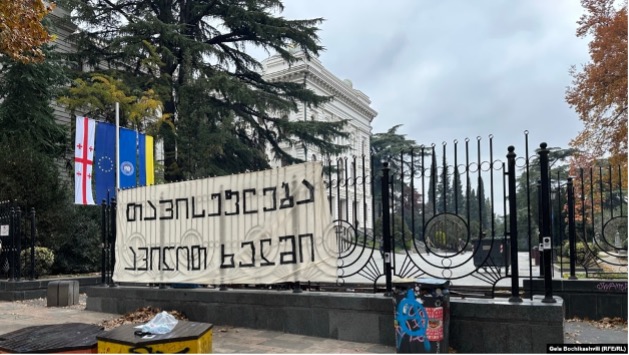
Picture 1:“Let’s take freedom into our own hands” – a protest banner on the fence of TSU’s main building. November 18, 2024. View the original photo on Radio Tavisupleba’s website. Photo © RFE/RL, by Gela Bochikashvili.

More importantly, I argue that it’s no longer just a personal choice for scientists to remain neutral. While science and politics have always been interwoven, in Georgia, this entanglement has become particularly visible, as politics -by the same old means- has directly entered academic spaces. At dawn on November 19, 2024, during a student protest at Tbilisi State University (TSU), the government deployed police forces onto campus to suppress the demonstrations. This was not metaphorical but physical invasion. When police walk into university lecture halls, academia enters what Kastenhofer (2024) calls a “survival mode” in which scientists become visibly activists and citizens and public intellectuals work not only to produce new knowledge, but to preserve the very space where knowledge can be made.

In Georgia, this is not only triggered by physical force but deepened by censorship and new legal restrictions that reshape what can be taught, discussed or funded in academia. In such moments, speaking out is not radical, it is vital. As Thierry et al. (2023) warned, there is “no research on a dead planet.” But what about a silenced university? A banned curriculum? A generation of students told not to ask certain questions? In my context, the warning is clear: without space for critical and independent inquiry, the kind of research necessary to challenge power and prevent authoritarianism becomes muted.

In response to police at university and ongoing protest suppression, many lecturers, professors at TSU’s Faculty of Social and Political Sciences issued a strong public statement, condemning the “brutal suppression of peaceful civil protests by law enforcement agencies” during which numerous journalists, ordinary citizens, students “injured through the use of disproportionate, and deliberate, force.”

Moreover, there was an institutional form of political interference. On September 17, 2024, the Georgian Parliament passed the Law on Family Values and the Protection of Minors. The government claims it protects “traditional” family structures, but in practice, it restricts the rights and visibility of sexual minorities. Its effects include educational institutions. Under the new law, not only schools but also universities are banned from “promoting“ or even discussing content that includes gender identities differing from biological sex or same-sex relationships.

In this case, politics did not arrive with batons, but with curriculum guidelines. Gender studies, queer theory and discussions of identity are now labeled as “propaganda.” As Teona Mataradze, a prominent sociologist and gender studies scholar, put it in an interview with Media Platform 64, “The MA program in Gender Studies at TSU, the first in the South Caucasus, loses its meaning under this law.”

So, instead of asking whether Georgian lecturers, most of whom are also active researchers, have the luxury of Weberian neutrality, we should ask what “neutrality” even means and does under these circumstances. Does “neutrality” mean to stay silent when policy dictates what we can teach and research? When funding is revoked for certain “banned” topics? As STS scholars have long argued, boundaries between academic inquiry and state power are often illusions; science and society are always entangled. In Georgia, these limits haven’t just blurred; they’ve been openly violated, pushing scholars into survival mode.

As Kastenhofer (2024) argues, we are now witnessing the rise of a “survival science”- a science that acknowledges the collapse of old rules due to societal changes and crises – climate emergency, threats to liberal democracies, growing inequality – that fundamentally change academic expectations, self-understanding and ethos, and force us to ask the question: “What are, and what should be, our new norms for science in society?” (p. 344). This includes, as Kastenhofer notes, “radical interventions“ like “scientists going on strike and taking to the streets” (p. 347).

That’s why, when Georgian researchers in the social and political sciences marched, spoke out and defended their students and academic values, I did not see these actions as unexpected or extreme – but as “radical interventions” that I understand not as political, but as academic acts carried out in survival mode, triggered by crises: threats to freedom of speech, the autonomy of academia and the presence of police forces at university. In Georgia too, academics have been forced to go further and ask a question that lies at the heart of survival science: what should science become when the basic conditions for doing science are under threat? I believe that in Georgia (as in the world), academics are in the process of creating the new moral and practical compass to guide them through survival – meaning a world full of uncertainty and societal crises. Seeing academics march and protest, lecturers speaking through microphones, and university classes held in the streets gives me the courage to say that this transformation – the creation of a new ethos – has already begun in Georgia.

And lastly, though this essay focuses on Georgia, the issue is borderless. In both non-democratic and democratic countries- even in the USA- academic freedom is increasingly at risk.


Ina Kaplanishvili is a Georgian master’s student in Science and Technology Studies at the University of Vienna, with a background in sociology from the Georgian Institute of Public Affairs (GIPA). Her current research interests include digital practices and technologies as actors in civic and protest engagement.


Bibliography

Arendt, H. (2017). The origins of totalitarianism. Penguin Classics.

Kastenhofer, K. (2024). From a normal and a post-normal science ethos towards a survival science ethos? GAIA – Ecological Perspectives for Science and Society, 33(4), 344-350. https://doi.org/10.14512/gaia.33.4.4

Thierry, A., Horn, L., von Hellermann, P., & Gardner, C. J. (2023). “No research on a dead planet”: Preserving the socio-ecological conditions for academia. Frontiers in Education, 8, Article 1237076. https://doi.org/10.3389/feduc.2023.1237076


[1] The document of „Law of Georgia on transparency of foreign influence“ (In English)

Dire wolves, Dire Consequences? De-extinction and technological solutionism

by Michal Nodzynski

When I was a kid, I was fascinated with dinosaurs and other examples of prehistoric fauna that have been long extinct. I often wondered how it would be to live among those species and interact with them.

And in a turn of events that would excite 10 year old me (and terrifies 30-year-old me), an American biotech company called Colossal Biosciences, announced on April 7th that it managed to ‘de-extinct’ Dire wolves through 3 puppies named Romulus, Remus and Khaleesi.

Dire wolves were ancient species of animals, believed to be related to gray wolves, that went extinct around 10,000 –13,000 years ago. In their prime, they were believed to inhabit a wide range of environments, from Canada in North America all the way down to Bolivia in South America.

The company managed to achieve this ‘de-extinction’ by editing 14 genes within the gray wolf genome to affect the phenotype (how the organism looks) of the wolves to resemble that of a dire wolf.

Promotional picture of the two gray wolf pups that the company genetically
modified to resemble dire wolves. Colossal Biosciences.

Now there has been already a serious discussion on whether the 3 puppies can be considered resurrected dire wolves or are just genetically modified gray wolves. It doesn’t help that there has been serious doubt whether modern gray wolves are actually the closest relatives of this extinct species. And on top of that, there are longstanding ethical issues connected with the practice of genetically modifying animals.

When it comes to ‘why?’ of ‘de-extinction, the leadership of the company points towards helping conservation efforts, increased biodiversity as well as potential way to combat climate change using de-extinct animals like mammoths to stop release of methane gas from thawing permafrost in the Arctic. This last theory is however not universally accepted by all researchers. For what it’s worth, George Church, geneticist and co-founder of Colossal Biosciences, compares such endeavours to “de-extinct” mammoths to “existing, rewilding projects” and seems not to be too concerned with potential implications of such “re-introduction”. This ‘downplaying’ of potential consequences could be beneficial for the public image of the company, and as such help with securing funding from private investors.

George R.R. Martin, author of ‘Game of Thrones’ fantasy book series,
holding one of the ‘dire wolf’ pups. The author was supposedly involved
in the process of de-extinction, and is even featured as one of the co-authors
of the pre-print paper that the company released on the preprint server bioRxiv.org.
George R. R. Martin

However, regardless of the validity of the claims about benefits of ‘de-extinction’ and soundness of scientific claims behind it, for me there is another angle that is worth exploring – the ‘techno-solutionist’ aspects of it.

Techno-solutionism is a term popularized by Evgeny Morozov in his book “To Save Everything, Click Here: The Folly of Technological Solutionism” (Morozov, 2013). The term is used there to describe the tendency of tech companies to look for digital solutions to different kinds of issues that contemporary societies deal with. Another term sometimes used interchangeably is ‘techno-fix’.

Whether it’s techno-solution or techno-fix, what I find interesting is the idea itself, that most societal problems could (and should) be addressed through the use of technology and innovation. The concept of ‘de-extinction’ very much embraces this way of thinking. Proponents of ‘de-extinction’ (such as George Church) emphasize that because issues, such as climate change, are so overwhelming and pressing, it justifies those unconventional approaches.

But techno-solutions often ignore that there exist well-researched and established ways of solving those issues. It’s just that often those solutions are not as ‘easy’ or as ‘quick’ as techno-solutionists would like them to be. Conservation efforts can be complicated, and they yield both successes and failures. But because they typically advocate restraint and harm reduction, they can be seen as ‘unattractive’ to those that prefer more decisive actions.

It’s also worth noting that conservational work is not universally opposed to use of modern technology. Frequently, conservational efforts take advantage of tools like tagging, drones or GPS data. Of course, even those technologies are not used uncritically. For example, the drones can be quite loud, and their deployment is only considered in cases where alternative, in-person intervention would be considered more disruptive to the environment.

And even so, those established technologies are sparsely used in the field. Researchers often highlight additional costs as well as poor adaptation of the equipment to the outdoor environment as one of the barriers to adapting technological tools in their work. In the end, the main issue in conservation isn’t lack of new technologies but lack of funding and interest from prominent stakeholders.

But what’s striking about those technologies in comparison to techno-fixes is what role they play in the process. Drones, satellites, and tags are there to support and enhance existing conservational frameworks. The work and research benefits from usage of those technologies, but does not depend entirely on them. The work could be done (albeit with more difficulty) without them. And in the end, the decision whether to use them or not is left to researchers and workers conducting those efforts.

On the other hand, techno-solutions often attempt to ‘disrupt’ established fields and completely change how issues are perceived and approached. And while this approach might work relatively well in markets focused on individual consumers[1] (such as consumer electronics or software) the consequences of failed ‘disruption’ in an environment-related field would be long-lasting and catastrophic.

The issue with techno-solutionist approach is that it not only ignores existing, non-technical, solutions, but it can even undermine them. Funding for conservation is already scarce and unevenly distributed. As such, some researchers worry that reallocating funds from undergoing conservation efforts towards de-extinction is simply not the most cost-efficient way to increase biodiversity.

Techno-solutions present a ‘quick’ technological fix that can appear to solve the problem without the need for deeper, structural changes, which more traditional approaches would call for. And when policymakers are both running out of time and money, techno-fixes can appear quite compelling.

It’s because of that need for urgency that techno-solutions are often proposed once ‘the issue’ reaches some sort of crisis. And this urgency can be then used as a way to legitimize those ‘fixes’ that otherwise would not be considered as a viable solution. For climate change, only now when the effects of it are obvious to everyone, are proponents of technologies such as Carbon Capture or Geoengineering becoming more bold and vocal about using them to address climate change.

Similar narratives can also be seen with ‘de-extinction’ movement. As conservation efforts become more difficult due to shifting political environments around the world, quick techno-fixes like ‘de-extinction’ can become more enticing to agencies and governments. In many ways, the tune changed from ‘there is no problem’ to ‘there is a problem, and we can only fix it now using technology’. This sense of urgency is a crucial element of techno-solutionisms, as it often allows it to bypass the usual assessment and public discussion that more established approaches require.

Technology might not be the solution, but it can definitely be part of it. But to do so, it has to work with people actively involved in conservational efforts and help them with addressing issues that they want to focus on. It also has to respect the voices and opinions of those that might be affected by deployment of said technologies. Conservational efforts to increase biodiversity shouldn’t have the same approach towards technology that in many cases caused the loss of said biodiversity.

It’s also worth highlighting that despite techno-solutionists claims that regulatory interventions don’t work – we have done that in the past. Remember the ozone layer hole? It’s still there, but studies have shown that since international efforts to reduce emissions of chlorofluorocarbons (CFCs) the ozone hole actually is slowly shrinking. This shows that coordinated, international regulatory efforts (which still include technological innovation) can work.

What personally scares me about techno-solutionist approach to conservational efforts is the potential for complete disregard for the well-being of currently living animals and their habitats. If we can ‘3D-print’ lions, why care about dying, sickly lions that currently roam the Earth? Let them die, and then we can just make more! It often seems easier to scrap everything and start from nothing rather than maintain what we might perceive as ‘flawed’ environment. We already see this type of thinking in politics when certain politicians call for heavy ‘budget cuts’ insisting on removing certain programs and funding with total disregard for how such cuts would affect people who rely on those funds. This might seem like a very pessimist view of de-extinction movement, but we’ve been similarly careless in the past with technologies of plastic, radioactive elements, nuclear waste. Techno-fixes of the past frequently ended up being equivalent of hiding the dirt under the rug and calling it ‘future-me’ problem. Except the future-us are the future generations that end up paying the price for our shortsightedness.

And honestly, Colossal Sciences shouldn’t try to impress 10-year-old me. If for no other reason, than simply because he was terrified of wolves.


Michal Nodzynski is a masters’ student at the Science and Technology Studies department of the University of Vienna. With background in molecular biology, his interests include how research in Life Sciences are conducted and communicated, with focus on perceptions of failures in research. Outside of academia, Michal is a huge nerd who enjoys fantasy novels and Tabletop Role-playing Games.


[1] Unfortunately, Colossal Biosciences approach to de-extinction seems to be close to Silicon Valley ethos of ‘move fast and break things’. Despite employing researchers, the company doesn’t publish their results in peer-reviewed journals and announces their results through press releases and photoshoots. There are very few instances where a company actually backs-up their claims with actual research (one rare example of that is the aforementioned 2025 preprint). Typical of techno-solutionism, the company promises quick and impressive results but is unable to explain how it plans to achieve them or even document what it has done so far. Not to mention addressing potential consequences of their interventions.

What’s it like working as a researcher?

By Sara Ortega Ramírez


“When I say, bluntly, that I am interested in learning how citizens in two countries make sense and care for the problem of nuclear residues, I can notice that they seem initially fascinated by the topic… but nevertheless, they don´t fully understand many things, such as why I want to know that… and perhaps the hardest question, what is the purpose of this? What is its utility?”


What do you do for a living? is a common question when meeting new people. A question not easy to answer if you are working in academia while doing a PhD, and the person asking this is not at all familiar with the academic world. Facing this question and the following one, such as, “what is your PhD subject?” has brought me serious challenges when trying to answer, leaving me wondering to myself about the sense and the purpose of working as a researcher in social sciences.  

It took me one full year to finally build my PhD project —my exposé— to be able to present it in front of the Doctoral School board of social sciences and be accepted. I can attest how the nebulousness I experienced during the first months when trying to explain to other people what I was doing started to become clearer, and I ended up feeling comfortable and being able to put into words what my subject and research interest are. However, this clarity doesn’t seem to reach others —relatives or strangers— who are not related to academia.

When I say, bluntly, that I am interested in learning how citizens in two countries make sense and care for the problem of nuclear residues, I can notice that they seem initially fascinated by the topic (I guess this is because they heard the word “nuclear”); but nevertheless, they don´t fully understand many things, such as why I want to know that, what I do in order to know that (what I do in a regular workday) and, finally, and perhaps the hardest question, what is the purpose of this? What is its utility?

If I am sincere, I’d just reply to the latter question that the relevance for me is to start to discuss, to mobilise among people, complicated issues that must be discussed collectively because they affect in several ways ours and others’ ways of living. Furthermore, as at any point in time decisions should be made concerning this kind of issues, it is better for us, as citizens, not only to be just informed but to have discussed this as a collective. But when I reply this, it still seems like this type of job remains at an abstract level. I am justifying knowledge by knowledge, as in a vicious circle.

This type of knowledge —i.e. how people think about nuclear residues— may be relevant for academia, but how does this matter to the economy of a country? To the well-being of the citizens? This does not sound like something useful in the sense of other jobs such as cleaners, doctors, designers, garbage collectors, lawyers, etc.

This had made me wonder about the characteristics of ‘research’ as a job, and not just as practice and passion. I cannot pinpoint specifically the usefulness of my job as I cannot have any type of certainty about how and by whom this knowledge will be used, and this can be disappointing, as it touches the ethical dimension and the responsibility implied in the research enterprise. I believe I cannot have a final answer to this.

I may have not the tools to fully explain to (or perhaps convince?) people not related to academia the importance of my job; nevertheless, it is still highly important —and valuable— at least for me, my supervisor, colleagues and the STS department, and hopefully it will be to some extent for academia as well. I guess we are just all performing different ways of valuing things.


Sara Ortega Ramírez is a doctoral candidate in the ERC-funded research project “Innovation Residues. Modes and Infrastructures of Caring for our Longue-durée Environmental Futures” at  the STS Department.