Field Trip: Reflections on the ‘before ruins’ Conference

by Finn

Since the beginning of my Master studies last fall I’ve continually struggled to figure out what STS does and how it fits with my own beliefs. Coming from the natural sciences, I felt some estrangement to what I perceived as a sometimes rather associative and arguably less rigorous style of thinking. I also haven’t had a clear understanding of the political claims of STS yet.

To explore some of those questions I thought it best to see some STS done outside of our cozy department in the top of NIG. So I skipped school for a few days and visited this year’s conference of the German STS society at Ruhr University Bochum. The theme was before ruins and I had a great time and met loads of nice people. I learned a lot from the very diverse talks (especially Anne Pasek’s awesome lecture on AI in Ruins) and enjoyed the dense studying experience.

Core to the conference was the experimental case format: almost a whole day was blocked for workshop-like explorations in groups around a topic or method, ranging from localartistic interventions to museum visits and discussions of academic boycotts. The cases were created by conference participants and placed in the center of the program, right between the opening event and association assembly on the first and the paper presentations on the third day.

As I had some prior curiosity about methods, I chose to participate in a case on computational approaches in STS. Due to my technical background, I also felt a little more confidentI’dbe able to at least contribute something there.

The six participants (including two digital humanities scholars organizing the case) toyed around with topic modeling to sort through a large collection of interview transcripts. After lunch we continued with the same body of text and prompted large-language models (LLMs) to reproduce analysis of passages using different hermeneutics (“You are a Social Scientist using Grounded Theory. Interpret the following passage:” or “You are Bruno Latour. Use your own theories and approaches to discuss the following text:”). Being in a fairly advanced stage of my anti-AI radicalization journey, it seemed dirty to learn from the LLM. I felt its infuriatingly clear and reductionist formulations had the potential to infect my thinking, tricking me into believing I could comprehend complex analytical frameworks just by reading a few churned-out paragraphs.

We discussed the results, critiques and potential usages for both technologies. All the typical worries about LLM output came up (flatness and oversimplification, lack of context and indiscriminate responses, etc.). Nevertheless, there still seemed to be a radical openness in the room towards both, a quantitative-y analysis as well as the straight-out outsourcing of analysis to LLMs. Obviously there

is some self-selection of case participants happening here. Still, in retrospect I also understand this as characteristic for a field in which, instead of building up schools and thought traditions that combine broad world views with methodological claims, scholars are free to pick and choose, entertaining a much more open attitude towards all kinds of experiments and interventions. The dissonance of attending a lecture on the ruins of AI on one day, while burning tokens the next, only fully became clear to me later.

They who do not want to talk about capitalism should not talk about capitalism”
Now she wants to engage with weapons manufacturers because critique out of distance ran out of steam a long while ago. I’m surprised and irritated, but interested”
wasn’t on my bingo card that a
Bundeswehr [German military] prof would hold a keynote there”1

This peculiar openness also showcased in the more immediately political topics. There seemed to be little consensus and much disagreement about the politics of research collaborations and corrupting effects of funding. To me, the discussion seemed a little crude at times. My impression was, that contributions often focused on the individual researchers room for maneuver without acknowledging the manifold nature in which systems exercise power, e. g. the legitimizing effects of critique and research. This still surprises me, since I assume those themes have been debated in STS for years and would’ve expected more nods to existing concepts and views. In this discussion, however, I also noticed the limits of my perception. As a newcomer I could follow the spin of what was asked and answered, but couldn’t make out the contours of the clashing factions for lack of contextualizing knowledge on the larger conflict lines within the field.

Only person in the room without a PhD”
currently being taught topic modelling [sic!]”

Nevertheless, it felt relatively easy to inquire about those contested topics and the atmosphere felt very open and somewhat pointedly anti-hierarchical. Especially the case format had participants of varying seniority thinking about something new together and thus facilitated becoming acquainted at eye level. However I suspect this particular culture regarding hierarchies to also be a feature of interdisciplinary approaches in general: if no one’s subject-related knowledge subsumes their conversational partner’s what else is there other than discussing on equal footing?

Still, I also felt some discomfort about the fact that disciplinary and status borders were, if not dissolved, then at least shaken up a little. I caught myself wondering about how I should even assert the substance and merit of what was said on stage. Does STS’ openness include a programmatic disengagement from a classical style of academic evaluation? How are the requirements of academic performance measures translated to fields of so little comparability? And of what attachments of mine does my unease speak here?

did you take anything sustainable from the convention? did you do something with it?”

Overall, before ruins taught me a lot. I met kind scholars who patiently explained their epistemic considerations to me and, while I remain skeptical in some regards, I understood others and got curious about more. Most of all, however, I got to know people making up a small corner of the STS community and gained much implicit knowledge about who is (doing) STS. I feel privileged to have become a little more part of the thought collective.

1 The Bundeswehr, Germany’s Military, sustains two civil universities. A faculty member of the University of the Bundeswehr Munich gave a talk at the conference.


Finn is a master’s student at the department with a background in Computer Science.

Pope Leo XIV’s “Magnifica Humanitas” and Science and Technology Studies: Reflections on artificial intelligence, technology, and humanity

by Proshant Chakraborty

For those who follow the discourse—and controversies—around Big Tech, perhaps you’ve noticed that Pope Leo XIV, as well as his predecessor Pope Francis, were not fans of technological capitalism.

The latest Encyclical from Pope Leo XIV, titled “Magnifica Humanitas,” however, does much more than call out the problems with Big Tech and artificial intelligence (AI), in particular. Instead, it offers what I believe is a rigorous and thoughtful mediation on technology, humanity, and spirituality—a trifecta that I, as an STS scholar and sociocultural anthropologist, find fascinating and worth exploring.

Furthermore, as someone who looks at both technology and capitalism through a critical lens, it’s also worth noting that Anthropic co-founder Chris Olah was the only tech company representative invited to speak at the Encyclical’s presentation at Vatican City.

As AI, and other related projects like data centers and autonomous weapons, become matters of concern (Latour 2004) for broader publics, we must pay closer attention to how institutions like the Vatican position themselves as part of changing dynamics and alliances.

So, as I’ve read both “Magnifica Humanitas”—which focuses on “safeguarding the human person in the time of artificial intelligence”—and Olah’s response to it over the past couple of days, I have been thinking about what these two interventions, one theological and the other technological, say about humanity and technology.

https://upload.wikimedia.org/wikipedia/commons/7/70/Pope_Leo_XIV.png
Fig. 1: Pope Leo XIV, author of “Magnifica Humanitas” (credit: Edgar Beltrán)

In this blog post, I will bring together some of key ideas from the Encyclical with (what I think are) relevant STS concepts or keywords in conversation. I then offer some remarks on Anthropic’s response to the Encyclical and what lessons we can discern from—and offer toward—this exchange about artificial intelligence and technological capitalism.

From the spectacular to the mundane

Speaking of theological, the Encyclical begins with a mediation on two Biblical images: the destruction of Tower of Babel and the rebuilding of the walls of Jerusalem.

In telling these stories—respectively, one a technological vision based on hubris and aspiring for homogeneity, and the other a collaborative and caring construction of a city—the Encyclical closely mirrors the way STS scholarship has discussed ideas of instrumentalism, determinism, and constructivism:

In the abstract, technology in and of itself is not a solution to humanity’s problems, just as it is not inherently evil. In practice, however, technology is never neutral, because it takes on the characteristics of those who devise, finance, regulate and use it. (§9)

To me, this excerpt comes close to what STS (Akrich 1992; Law 2011) and the anthropology of technology (Pfaffenberger 1992) consider as sociotechnicality—the idea that technologies or technical artefacts are both the product of, but also produce, social practices; that social practices, too, involve human engagement with a whole host of nonhumans, organic and artificial alike; and that these relations open up questions of power and politics (Winner 1980).

Which brings me to the second keyword: infrastructure. In many ways, infrastructures are a great example of sociotechnical systems. They are made of layers upon layers technical objects and technologies (Bowker & Star 1999; Star 1999); constructing and operating them requires expertise and labour (Anand 2017; Harvey & Knox 2015); and, perhaps most importantly (at least in my view), because infrastructures require planning and make life possible for large groups of people, they raise questions around repair, maintenance, and reproduction of power (Henke & Sims 2020).

In the Encyclical, these ideas perhaps find most resonance in the Social Doctrine of the Church, which is a vital thread that runs throughout the document. While the core principles of the Social Doctrine were first developed in Pope Leo XIII’s 1891 Encyclical on capital and labour, which was concerned about the effects of the Industrial Revolution, “Magnifica Humanitas” updates these principles for the digital age.

In the digital age, the principles of the common good and the universal destination of good, for example, “must also include new forms of property, such as patents, algorithms, digital platforms, technological infrastructure and data” (§67). Likewise, the Encyclical highlights how principles of solidarity and social justice relate to important ethical questions when it comes to digital technologies, especially in providing “equal access to opportunities,” “combat[ting] hate and misinformation,” and subjecting “the use of data and technology to public oversight” (§80).

Artificial intelligence

We now come to the most relevant—and critical—part of the Encyclical: its discussion of artificial intelligence.

From the very outset, the Encyclical outlines its critique of technocratic power, particularly the fact that today’s Big Tech companies increasingly control vast resources, natural and artificial alike; and because of the concentration of power and lack of government oversight, these companies are unaccountable to the people from whom they extract wealth.

To meet these challenges, Pope Leo XIV calls for regulations, discernment, and disarmament, which closely echo the positions of most progressive and democratic politicians organizing against AI and Big Tech, like Senator Bernie Sanders and Congresswoman Alexandria Ocasio Cortez in the US.

And while the Encyclical acknowledges the scientific and technological complexity of the topic, it suggests that “we must avoid the misconception of equating this type of ‘intelligence’ with that of human beings,” and states:

So-called artificial intelligences do not undergo experiences, do not possess a body, do not feel joy or pain, do not mature through relationships and do not know from within what love, work, friendship or responsibility mean. Nor do they have a moral conscience, since they do not judge good and evil, grasp the ultimate meaning of situations, or bear responsibility for consequences. They may imitate language, behavior and analytical skills, or even simulate empathy and understanding, but they do not understand what they produce, for they lack the affective, relational and spiritual perspective through which human beings grow in wisdom. (§99)

“Statistical adaptation,” the Pope concludes, “does not imply inner growth.”

In contrast to the Encyclical’s cogent technoscientific assessment of AI, Anthropic co-founder Chris Olah’s response falls back to an anthropomorphic view of AI that keeps conflating mathematical models with human emotional responses. He writes

we keep finding things that are mysterious, even unsettling. We find structures that mirror results from human neuroscience. We find evidence of introspection. We find internal states that functionally mirror joy, satisfaction, fear, grief, and unease.

Despite its critique of AI, Pope Leo XIV also accepts the inevitability of AI as something which is here to stay, which perhaps explains why Anthropic—a company which refused to work with the US Department of War and is “widening conversation” with experts in philosophy and religion—was given a seat at the table.

I find the Pope’s critique of tech’s “anti-human vision” and his assumption that today’s tech corporations can be regulated or disarmed to be puzzling (if not contradictory). That said, the Encyclical has without a doubt created space in the public sphere and consciousness where STS scholars—as members of diverse communities and social groups—can further problematize these technologies and the corporations responsible for designing and profiting from selling AI (which include Anthropic as well).

***

In conclusion, I believe “Magnifica Humanitas” invites questions from—and perhaps even provides insights toward—STS and other social sciences. This is especially evidence in how Pope Leo XIV draws on the insights of the human and social sciences in the document; and many scientific advisors from the Pontifical Academy of Social Scientists worked on the Encyclical, as well (thanks to my colleague Gernot Rieder for pointing this out while commenting on this post).

In that spirit, some of the topics that can spark further discussions could include Pope Leo XIV’s religious reflections on transhumanism, posthumanism, and more-than-human perspectives. While these themes are well-researched in STS, albeit from a secular perspective, questions remain on how divinity, spirituality, or belief—and the values they represent—find resonance in sociotechnical domains (Ishii 2017), which was certainly the case in my work on repair and maintenance in the Indian Railways (thanks to Carsten, our blog editor, for pointing this out).

Fig. 2: Jesus Christ at the Car Shed (© Proshant Chakraborty)
Fig. 3: Hindu Gods at the Car Shed (© Proshant Chakraborty)

Personally, I found the Encyclical to be a profound meditation on technology and human labour, and what it means to create and be in communion with others—whether it be humans, God, or especially even sociotechnical systems.

At the same time, I also hope this post serves as an invitation to the STS community, especially our students and junior colleagues, who are perhaps most impacted by the disruptive effects of AI in higher education, to share their ideas, thoughts, and critiques.

And that, in doing so, we can learn about—and even create—alternative visions of technology and society, visions that could very well align with the Encyclical’s perspectives on truth, democracy, education, communication, labour, and the environment (thanks again to Gernot for pointing this out).

References

Akrich, Madeleine. “The De-scription of Technical Objects.” In Shaping Technology/Building Society. Studies in Sociotechnical Change, edited by Wiebe E, Bijker. Cambridge, Mass.: The MIT Press, 1992.

Anand, Nikhil. Hydraulic City: Water and the Infrastructures of Citizenship in Mumbai. Durham: Duke University Press, 2017.

Bowker, Geoffrey C, and Susan Leigh Star. Sorting Things Out: Classification and Its Consequences. 1st ed. Cambridge: The MIT Press, 2000.

Harvey, Penelope, Hannah Knox, and Cornell University Press. Roads: An Anthropology of Infrastructure and Expertise. Ithaca London: Cornell Univ. Press, 2015.

Henke, Christopher, and Benjamin Sims. Repairing Infrastructures: The Maintenance of Materiality and Power. Cambridge, Massachusetts: The MIT Press, 2020.

Ishii, Miho. 2017. “Caring for Divine Infrastructures: Nature and Spirits in a Special Economic Zone in India.” Ethnos 82 (4): 690–710. doi:10.1080/00141844.2015.1107609.

Latour, Bruno. “Why Has Critique Run out of Steam? From Matters of Fact to Matters of Concern.” Critical Inquiry 30, no. 2 (2004): 225–48. https://doi.org/10.1086/421123.

Law, John. “Heterogenous Engineering and Tinkering.” Heteregeneities.net. 14 November, 2011. http://www.heterogeneities.net/publications/Law2011HeterogeneousEngineeringAndTinkering.pdf.

Pfaffenberger, Bryan. “Social Anthropology of Technology.” Annual Review of Anthropology 21 (1992): 491–516. http://www-jstor-org.uaccess.univie.ac.at/stable/2155997.

Pope Leo XIV. Magnifica Humanitas [Encyclical Letter on Safeguarding the Human Person in the Time of Artificial Intelligence]. The Holy See. May 15, 2026. https://www.vatican.va/content/leo-xiv/en/encyclicals/documents/20260515-magnifica-humanitas.html.

Star, Susan Leigh. “The Ethnography of Infrastructure.” The American Behavioral Scientist 43, no. 3 (1999): 377–91. https://doi.org/10.1177/00027649921955326.

Winner, Langdon. “Do Artifacts Have Politics?” Daedalus 109, no. 1 (1980): 121–36. http://www-jstor-org.uaccess.univie.ac.at/stable/20024652.


Proshant Chakraborty, PhD is University Assistant (Postdoc) at the Department of Science and Technology Studies, University of Vienna. His research examines human-technology relations at the intersections of algorithms, artificial intelligence and technological capitalism. Proshant’s other research interests include the anthropology of infrastructure, gender studies, feminist technosciences, and urban studies.

A Conversation on AI Policy, Governance, and the Making of Academic Work

A conversation between Bao-Chau (Bao-Chi) Pham and Katja Mayer

We’re excited to share an interview with our colleague Bao-Chi, whose recent publications on artificial intelligence policy and governance offer fresh and critical insights into the field. Bao-Chi’s work highlights the socio-political imaginaries of AI, focusing on concepts such as risk, trust, and how global contexts shape perceptions of AI’s challenges and opportunities. These papers not only enrich scholarly debates but also provide a window into the process of academic publishing itself—a process of making knowledge that often remains invisible.

Katja: In this conversation, we’re taking a dual approach. First, we explore the content of Bao-Chi’s papers—their core arguments and contributions to the field of AI policy and governance. Then, we shift focus to the process—the often overlooked aspects of research, writing, collaboration, and peer review that shaped the final publications.

We believe that reflecting on how scholarly work is produced is as important as discussing what it argues. By uncovering these processes, we aim to demystify academic publishing and inspire reflection on our collective research practices.

Bao-Chi, could you start by introducing yourself and telling us about your PhD journey? What led you to focus on AI governance, and how did these two papers emerge from your research?

Bao-Chi: Thanks a lot for the introduction, Katja. Since joining the Vienna STS department in September 2020, I’ve been working on my PhD project “Imagining and Governing Artificial Intelligence in Europe”. My research explores how AI and Europe are co-produced in political and policy discussions. In other words, I study imaginaries that shape these conversations and how particular visions of AI and “Europeanness” are enacted, circulated, and stabilized.

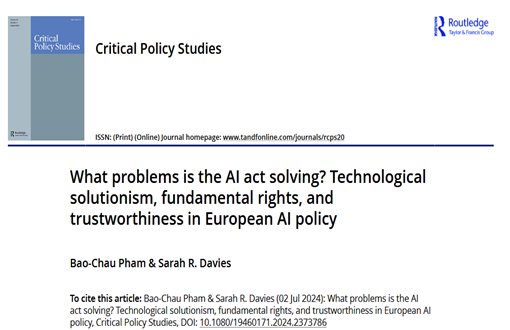
The two papers we’re discussing today are part of my cumulative dissertation. The first, co-authored with my supervisor Sarah Davies, was published in Critical Policy Studies under the title: What problems is the AI Act solving? Technological solutionism, fundamental rights, and trustworthiness in European AI policy.

In this paper, we examine the European Union’s AI Act, a regulatory framework initiated by the European Commission, which came into force on 1 August 2024. Among other concrete measures, the AI Act introduces a risk-based tier system that stipulates what kind of oversight measures the AI systems deployed and implemented in Europe are subjected to.

“…the AI Act enacts a particular vision of Europe – one that positions the EU as an exceptional regulatory leader and reinforces the idea of the EU as a coherent political community. This, in turn, forecloses other possible ways of characterizing and addressing AI as a policy issue.

The two papers we’re discussing today are part of my cumulative dissertation. The first, co-authored with my supervisor Sarah Davies, was published in Critical Policy Studies under the title What problems is the AI Act solving? Technological solutionism, fundamental rights, and trustworthiness in European AI policy. In this paper, we examine the European Union’s AI Act, a regulatory framework initiated by the European Commission, which came into force on 1 August 2024. Among other concrete measures, the AI Act introduces a risk-based tier system that stipulates what kind of oversight measures the AI systems deployed and implemented in Europe are subjected to.

We analyse the AI Act using Carol Bacchi’s What’s the Problem Represented to Be? (WPR) approach, which highlights how policies actively construct the very problems they claim to address. By focusing on the AI Act’s risk-based classification system, we unpack how AI is problematized within EU policy-making. Beyond that, we consider the effects of these problem representations – not just in terms of measurable policy outcomes but also in what John Law refers to as collateral realities. Our key argument is that the AI Act enacts a particular vision of Europe – one that positions the EU as an exceptional regulatory leader and reinforces the idea of the EU as a coherent political community. This, in turn, forecloses other possible ways of characterizing and addressing AI as a policy issue.

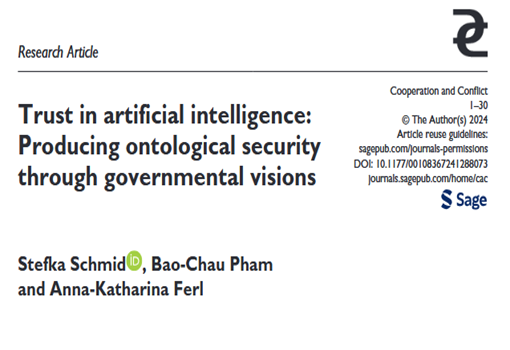
The second paper, Trust in AI: Producing Ontological Security through Governmental Visions published in Cooperation & Conflict, is co-authored with Stefka Schmid (TU Darmstadt) and Anna-Katharina Ferl (Stanford University) and emerged from our interdisciplinary discussions on AI governance and security. We take a comparative approach, analysing EU, US, and Chinese AI policy documents to explore how AI is framed as a security concern, not just in military but also in civilian contexts.

Our key argument is that AI policies shape future visions by fostering ontological security – a sense of stability and continuity in a state’s identity which is reaffirmed, for example, through the performance of familiar routines and narratives, and the maintenance of relationships. While AI is often framed as a national security threat, we find that policies also draw on Human-Computer Interaction (HCI) concepts, such as trust, to position AI as a manageable and governable object. By introducing ontological security into AI governance debates, our paper highlights how policies don’t just regulate AI as a technology. They also help governments and institutions maintain a stable self-image by positioning AI as something controllable, thereby reinforcing trust in governments.

The Writing Process: From Ideas to Published Work

Bao-Chi: Looking back, both papers were shaped by informal exchanges and unexpected opportunities, and both stem from conference experiences.

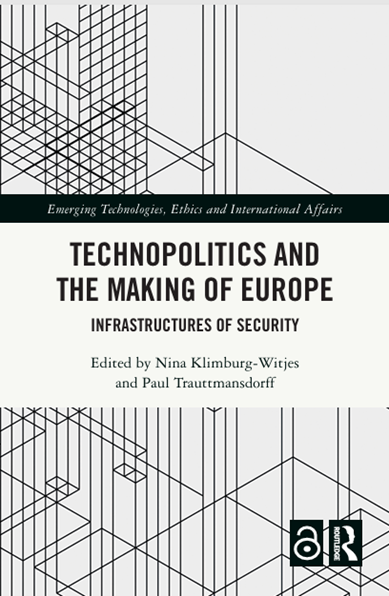
The first paper emerged from a workshop in Graz in September 2021, organized by STS Austria. I wasn’t presenting my own research but a collaborative autoethnography project with our colleagues Fredy Mora Gámez, Andrea Schikowitz, Sarah Davies, and Esther Dessewffy. One evening, Nina Klimburg-Witjes mentioned that she and Paul Trauttmansdorff were editing a volume called Technopolitics and the Making of Europe Infrastructures of Security, bringing together debates from STS and Critical Security Studies. She asked whether Sarah and I would be interested in contributing a chapter on AI. At that point, I had only just begun my empirical work on European AI policy, but we agreed it was a great opportunity. Writing that chapter, in which we conceptualized AI policy as infrastructure, was the springboard for our paper.

When Sarah and I began working on the paper, I came across the WPR approach. Bacchi and Goodwin’s Poststructural Policy Analysis: A Guide to Practice (2016) was particularly helpful in my own grappling with a core STS principle: that things could be otherwise. The idea that policies don’t just respond to problems but actively shape what is seen as a problem aligned closely with my interest in the co-production of AI and Europe. The WPR approach also provided a practical way to navigate the AI Act, a dense and technical legal text. The framework’s seven guiding questions structured our analysis and allowed us to address audiences beyond STS, particularly policy-makers and practitioners. In many ways, applying WPR to the AI Act was a way to translate STS sensibilities to a broader audience.

Similarly, the second paper emerged from a conference experience. In 2021, I submitted an abstract to the Science, Peace, and Security conference. A few weeks later, the organizers emailed me, copying in another participant whose abstract was very similar. They suggested we either collaborate or decide who would present, while the other could produce a poster. I remember feeling apprehensive: was this my first encounter with the infamous competitiveness of academia? I was very happy to collaborate, but I also wondered: was that the “strategic choice” an early-career researcher should make? Anna and I reached out to each other, got along brilliantly, and decided to work together. Stefka was in the online audience during our presentation and later reached out because she was intrigued by our use of sociotechnical imaginaries. She was working on a comparative project on AI governance and suggested we collaborate.

As we developed the paper, we turned to the concept of ontological security, which we hadn’t yet seen discussed much in relation to AI. AI policy, especially in international relations and military contexts, often focuses on hard security, meaning physical threats to state sovereignty or military stability. We were interested in what else these policies were doing. Drawing on Lupovici’s work (2022) on ontological security and cybersecurity, we explored how AI policies don’t just address external threats but also help sustain a sense of stability and identity.

In this way, both conceptual approaches – WPR and ontological security – helped my co-authors and me to move beyond instrumental, techno-solutionist understandings of AI governance. They allowed us to ask what policies do beyond regulating technology: how they shape identities and visions of the future. These perspectives also make our work more accessible to broader audiences. The WPR approach offers a structured way to reflect on how policy frames the problems it addresses. Ontological security, meanwhile, provides a language for thinking about AI policy not just in terms of risk management or security threats but in terms of how states and institutions construct meaning and stability alongside technological change.

The Role of Collaboration

“…having regular discussions with our colleagues about what counts as authorship, how to acknowledge contributions, and what is expected of each collaborator was immensely helpful in setting and managing expectations and workload.”

Bao-Chi: Absolutely, collaboration was central to both papers, but the experiences were quite different, each shaping my growth as a researcher.

Working with Sarah on the first paper was my first journal article and my first as a lead author. Writing with someone more experienced and in a clear position of seniority brought a certain safety but also required some navigation. On the one hand, I benefited enormously from Sarah’s guidance, particularly in structuring the paper, crafting a clear argument, and writing for an academic audience. On the other, I was learning to find my own voice as an early-career researcher, constantly asking myself, “What do I think is important? What do I want to say, and how? Is this good enough for an academic publication (and ultimately for my PhD)?” More than once, I felt stuck, procrastinated, and pushed back deadlines. This didn’t feel great in a collaboration, especially with my supervisor. I really appreciated Sarah’s patience and encouragement, and that she didn’t “need” this paper for her publication record – it was about getting me over the line with my first paper – and she was happy to let me take the lead and work at my own pace.

Here, having regular discussions with our colleagues about what counts as authorship, how to acknowledge contributions, and what is expected of each collaborator was immensely helpful in setting and managing expectations and workload. It also proved incredibly useful for the second collaboration, which had a very different setup.

Stefka, Anna, and I work in different disciplines (Computer Science, Peace Studies, and STS) and at different institutions in Germany and Austria. We were also all PhD candidates at the time. All of this meant that integrating our perspectives took extra effort. Our collaboration was mostly mediated by digital tools – Zoom for discussions, Stefka’s university’s cloud system for file-sharing, and Overleaf, a LaTeX editor, for drafting, which – I’ll be honest – was clunky at times! But those logistical hurdles were secondary to the real task: ensuring all three of our voices were present in the paper. Since for two of us the paper counts towards our dissertations, it felt particularly important that we each saw ourselves reflected in the final text.

“I also realized how much I had taken certain STS tenets for granted, such as that technologies don’t simply exist but are always co-produced with societal and political orderings. Explicitly articulating that to my collaborators, both in writing and discussions, made me more aware of my own assumptions”

The first paper gave me practical experience to write in an STS style and to develop a clearer sense of what “good writing” looks like in our field. That, in turn, helped me push back at certain points in the second paper’s interdisciplinary writing process when I felt the STS perspective risked getting lost. At the same time, I was also learning from my co-authors: both Stefka and Anna would highlight aspects that required more precision in their own disciplines. I started to notice a shift in my role – from receiving feedback on my first paper to flagging when our argument needed sharpening in the second paper. I also realized how much I had taken certain STS tenets for granted, such as that technologies don’t simply exist but are always co-produced with societal and political orderings. Explicitly articulating that to my collaborators, both in writing and discussions, made me more aware of my own assumptions.

In short, both collaborations shaped me in different ways. The first paper grounded me as an STS scholar; the second challenged me to articulate that position in a broader interdisciplinary conversation while also learning from other disciplines and their conventions.

The Peer Review Journey

“Having someone engage thoughtfully and thoroughly with our work felt like entering into a conversation, rather than receiving a one-sided judgment”

Katja: The peer review process is often challenging yet transformative. How did it shape your papers? Did you adapt your writing style for different journals or audiences? What was it like navigating reviewer feedback, and how long did the process take? We’d love to hear any advice you have for early-career researchers about managing revisions and responding to reviewer comments constructively.

Bao-Chi: I was initially apprehensive about the peer review process, especially with cautionary tales and the notorious “reviewer 2” memes circulating online. However, I was pleasantly surprised by how constructive and insightful the reviews were, despite the process not being entirely smooth (but then, which review process ever is?).

For the first paper, the review process took 15 months from submission to publication. Instead of harsh comments, reviewer 2’s feedback was minimal – only one sentence – so the editor reached out to a third reviewer for a more substantial response. Despite the lengthy process, the feedback was very helpful in refining the argument. In particular, the reviewers criticized the policy solution we aimed to unpack using the seven-step WPR approach. This led us to focus on the AI Act’s risk-based classification system, rather than the more ambiguous “trustworthy AI” policy discourse, which, I think, ultimately strengthened our paper.

Having someone engage thoughtfully and thoroughly with our work felt like entering into a conversation, rather than receiving a one-sided judgment. Sarah also introduced me to a very useful system for addressing peer review, which I’ve continued to use ever since: creating a table with each comment and treating it like a to-do list. This made the revision process more structured and helped me manage what would otherwise feel incredibly overwhelming.

For the paper with Stefka and Anna, we received a desk rejection from another journal just before Christmas. Had I been on my own, I might have been discouraged by the setback, but I am grateful that Stefka quickly resubmitted the paper to Cooperation and Conflict and after review and 9 months, the paper was accepted.

In terms of revisions, the feedback helped us sharpen our argument and better highlight our contribution. For example, one reviewer suggested we clarify the literature we were engaging with, suggesting to better contextualize and acknowledge the works we were drawing on. This not only strengthened our own contribution but also helped us link to the literature more effectively into the empirical sections. Having an external voice pointing out areas where we had made implicit connections that were unclear to readers was very useful in streamlining and signposting our text.

Overall, I found the review process to be far more collaborative and rewarding than I had expected (though, it definitely helped that both papers were co-authored to begin with). It reminded me that revision is an essential part of the academic writing journey, that can help sharpen ideas and strengthen the argument.

A final piece of advice: treating the review process like a to-do list has been extremely useful to me in knowing when to stop editing. It gives you a clear goal: addressing all the comments, either by integrating them into the text or justifying why you chose not to, helped me understand when the papers were “ready” for publication. This is something we often don’t have when preparing papers for initial submission.

Wrapping Up: Reflecting on Key Themes

Katja: Before we close, let’s return to the papers’ content. What key themes connect them? What motivates you in your research, and what messages were you aiming to convey? How do you see these papers contributing to ongoing debates in AI governance?

“AI policy is not just about managing technological risks and their implications but also actively shapes how AI is understood and governed – that is, how AI is made doable and thinkable… policy shapes what AI is understood to be and what kinds of futures become possible.”

Bao-Chi: A key theme in both papers is that AI policy is not just about managing technological risks and their implications but also actively shapes how AI is understood and governed – that is, how AI is made doable and thinkable. In other words, policy shapes what AI is understood to be and what kinds of futures become possible. Both papers therefore take a co-productionist perspective, highlighting how policy is neither neutral nor inevitable but instead reflects specific political choices and value-laden assumptions. The first paper examines how the AI Act constructs a particular vision of AI through its risk-based classification system, reinforcing specific political choices and particular visions of Europeanness. The second paper explores the role of ontological security, demonstrating that AI policies do not just regulate technology but also aim to provide a sense of stability in a rapidly shifting technological landscape.

What motivates my research is to critically examine how AI is framed, governed, and imagined, and to explore how things could be otherwise. Much of the current AI policy debate is framed in narrow, technical terms, focusing on terms like trust, risk, transparency, and explainability. At the same time, we also see non-governmental actors, particularly large technology companies, increasingly shaping these discussions. In this context, I am especially interested in how policies that appear neutral or solution-oriented actually reproduce and circulate implicit assumptions about what kind of AI – and what kind of society – we should be striving for. By unpacking these assumptions, our research contributes to challenging dominant narratives and opening up space for alternative ways of thinking about AI governance and what kinds of future are made possible or foreclosed through it.

Katja: Thank you so much, Bao-Chi, for sharing these reflections. We’re inspired not only by your research but also by your openness in discussing the academic process. Your insights on collaboration, writing, and peer review offer valuable lessons for all of us dealing with the complexities and often pressures of scholarly publishing.